
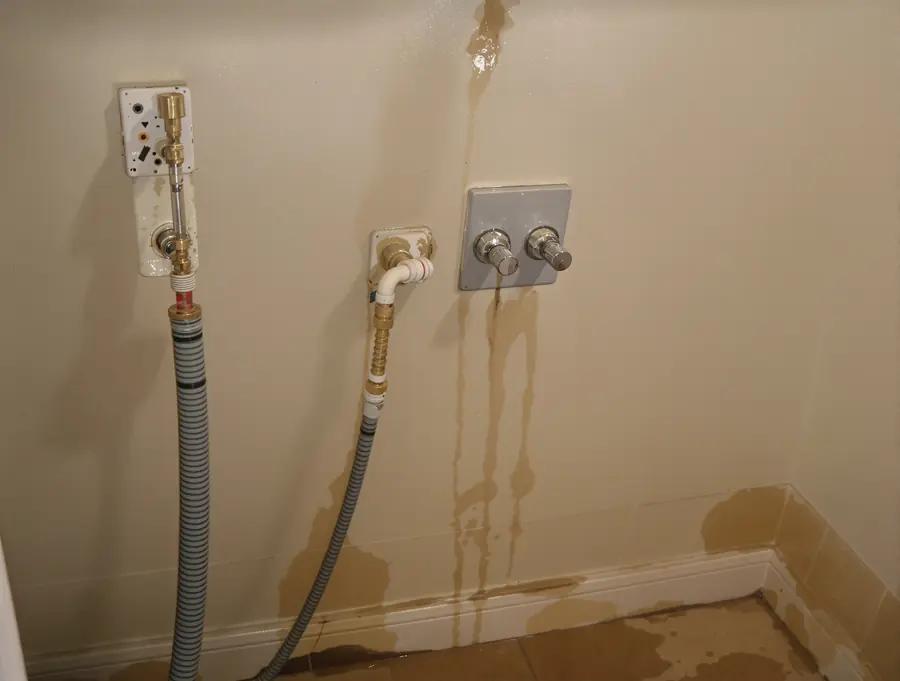
Most Las Vegas homes sit on a concrete slab with no basement, so a washer leak has nowhere to go but out across the floor and up into the drywall. That makes one question matter more than any other. Did the water come from the supply side or the drain side? A drain side leak stops when the load runs out, but a supply side leak runs until somebody closes a valve. It’s the first thing we ask on a laundry room call, because the cleanup looks very different. A burst supply line caused half of all washing machine water damage in a study by the Insurance Institute for Business and Home Safety, and those losses averaged more than $6,000 each.1
Two Kinds of Washer Leak
Every washer has two water paths. Clean water comes in from the wall through two inlet hoses, one hot and one cold. Used water goes out through the drain hose into a standpipe or a laundry tub.
The drain side has a ceiling. A standard washer uses about 20 gallons a load, and an ENERGY STAR model uses about 14.2 If the drain hose pops loose, you lose that load’s water and not much more. That’s a mess, not a flood.
The supply side has no ceiling. Those inlet hoses hold house pressure all day, every day, unless the valves behind the washer are closed. When one splits, it keeps feeding water whether the washer is running or not.
That’s why the age of the hose matters so much. Washing machine makers recommend replacing inlet hoses every 5 years, and the IBHS guidance says cracks, kinks and blisters show up most often near the connection.1
Find the Source by Where the Water Shows Up
Watch where the water appears and when. That tells you more than the size of the puddle.
Behind the Washer While It Fills
Look at both ends of each inlet hose. Whirlpool says to confirm there’s a rubber hose washer at each end and that every connection is tight.3 A hose that’s wet along its length, bulging or cracked gets replaced, not tightened.
Behind the Washer While It Drains
Now the drain hose is the suspect. Whirlpool says the sink or standpipe has to carry away at least 17 gallons a minute.3 A slow or partly clogged household drain can’t keep up, so the standpipe overflows down the wall. The hose shouldn’t reach more than 4.5 inches into the drainpipe, and it should never be taped in, because it needs an air gap.4
Under the Front or Bottom
Suds are a common cause. Whirlpool says using too much detergent, or detergent that isn’t HE, can make excess suds that leak, and so can no splash or easy pour bleach.5 On a top loader, adding clothes after the cycle starts at the highest water level can spill water over the tub.3
On the Floor When Nothing Is Running
This one points straight at the supply side. A washer that’s off has no drain flow, so water showing up anyway means something under house pressure is weeping. Check the valves, the hose ends and the hoses themselves. Close the valves until it’s fixed.
If the washer keeps filling past its normal level, treat that as a supply side problem too. Water is still coming in from the wall. It’s just leaving through the tub.
The First Hour After the Leak
- Close both valves behind the washer. If you can’t reach them, or they won’t turn, close the main shutoff for the house.
- Don’t stand in water to unplug the washer. If the outlet or cord is wet, turn the power off at the breaker first.
- Take photos and video before you clean up, with the date showing. Our guide on documenting water damage for insurance walks through what to capture.
- Pull up standing water with towels or a wet vac. Then pull the washer out and look behind it, since that’s where the worst of it usually sits.
- Lift rugs and move anything stored on the floor. Check the baseboards and the bottom of the drywall on every wall the water touched.
- If the laundry room is upstairs, check the ceiling below for stains, sagging or drips.
Drain water is used wash water, with soil and soap in it. Treat a drain side spill as dirty water. Clean and disinfect the floor, don’t just dry it.
Why the 48 Hour Clock Matters Here
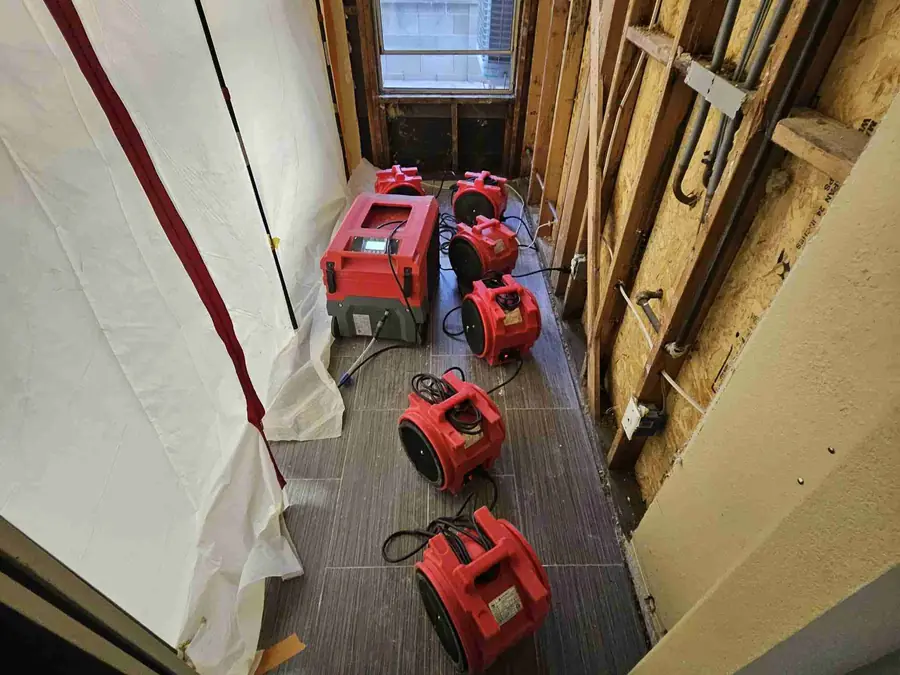
The EPA says water damaged areas and items should be dried within 24 to 48 hours to prevent mold growth, and in most cases mold won’t grow when materials are dried in that window.6 It also lists the underside of carpet and pad as a place mold hides.6
That clock is the real reason a washer leak turns into a bigger job. A floor that looks dry by evening can still be wet under the baseboard and inside the bottom of the wall. Laundry rooms are small and closed in, and water that runs behind a washer often sits where nobody looks for days.
A moisture meter settles it. If the drywall, the baseboard or the subfloor still reads wet after the surface dries, it needs real drying equipment, not a box fan.
Upstairs laundry is the worst case. Water from a second floor washer can run through the subfloor into the ceiling of the room below. Our page on ceiling water damage covers what that drying looks like.
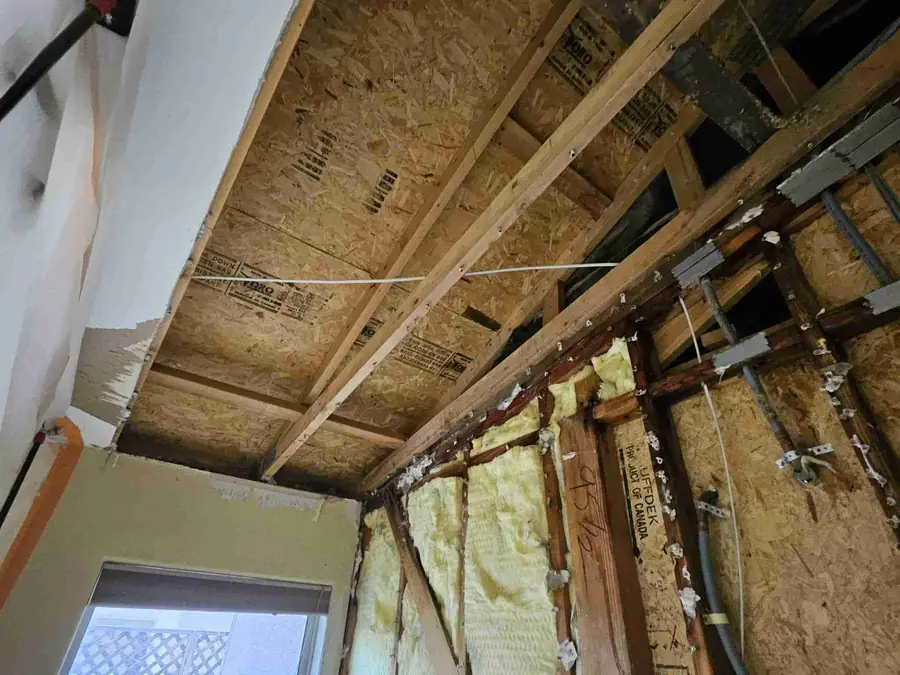
For a leak that has already reached the walls or the room next door, the page on appliance leak water damage covers washers, dishwashers and fridges.
Hose and Valve Habits That Stop the Next One
Nearly all of these come from the IBHS water damage guidance.1 None of them cost much.
- Inspect both inlet hoses every 6 months. Look hardest near the fittings, where cracks and blisters show up first.
- Replace the hoses every 5 years, even if they look fine. Reinforced braided stainless steel hoses are worth the small upgrade.
- Leave 3 to 4 inches between the back of the washer and the wall, so the hoses don’t kink at the valve.
- Hand tighten each connection, then add about two thirds of a turn with pliers. Don’t crank it past that.
- Turn the supply valves off when the washer isn’t in use. A lever style valve makes that a two second habit.
- Don’t run the washer when nobody is home.
Test your valves before you need them. Our water is rated very hard, at 16 to 17 grains per gallon,7 and a valve nobody has touched in years is worth a turn to make sure it still closes.
Use HE detergent in the amount on the label, and keep the drain hose seated loose in the standpipe with its air gap. Those two steps cover most drain side leaks.45
We close with one thought. A washer leak is the rare water problem you can see coming. Five minutes behind the machine twice a year beats a week of fans in the hallway.
Things to Settle
Is a leaking washing machine an emergency?
A supply side leak is, because it won’t stop on its own. Close the valves behind the washer or the main shutoff right away. A small drain side drip that stops when the cycle ends can usually wait for a repair, but dry the floor and the wall base the same day.
Why is my washing machine leaking water even when it’s off?
The inlet hoses stay under house pressure unless the valves are closed, so a weeping hose end, a worn hose washer or a split hose can leak with the machine off. Close both valves and inspect the hoses and fittings.
Can I still use my washing machine if it’s leaking?
Not until you know where the water comes from. If the source is a supply hose or valve, keep the valves closed until it’s replaced. If it’s suds or a loose drain hose, fix that first, then run a short cycle while you watch it.
Why has my washing machine flooded my floor?
The usual causes are a burst inlet hose, a drain hose that slipped out of the standpipe, a household drain that can’t keep up, or too many suds. Where and when the water shows up points to which one.
How often should washing machine hoses be replaced?
Every 5 years is what washer makers recommend, with an inspection every 6 months in between. Replace any hose sooner if it shows cracks, kinks or blisters.
Studies and Pages
| What We Cited | Where It Came From |
|---|---|
| 1. Supply line bursts in half of washer losses, losses over $6,000, hose replacement every 5 years, inspection and install tips | Insurance Institute for Business and Home Safety, published by the Connecticut Insurance DepartmentNov 2026 |
| 2. Water used per load, 14 gallons for ENERGY STAR and 20 for standard washers | ENERGY STARNov 2026 |
| 3. Hose washer checks, the 17 gallon a minute drain rule, adding clothes mid cycle | Whirlpool Product HelpNov 2026 |
| 4. Drain hose depth of 4.5 inches, no tape, air gap | Whirlpool Product HelpNov 2026 |
| 5. Excess suds from detergent and easy pour bleach | Whirlpool Product HelpNov 2026 |
| 6. Drying within 24 to 48 hours to prevent mold, mold under carpet and pad | US EPANov 2026 |
| 7. Local water hardness of 16 to 17 grains per gallon | Las Vegas Valley Water DistrictNov 2026 |